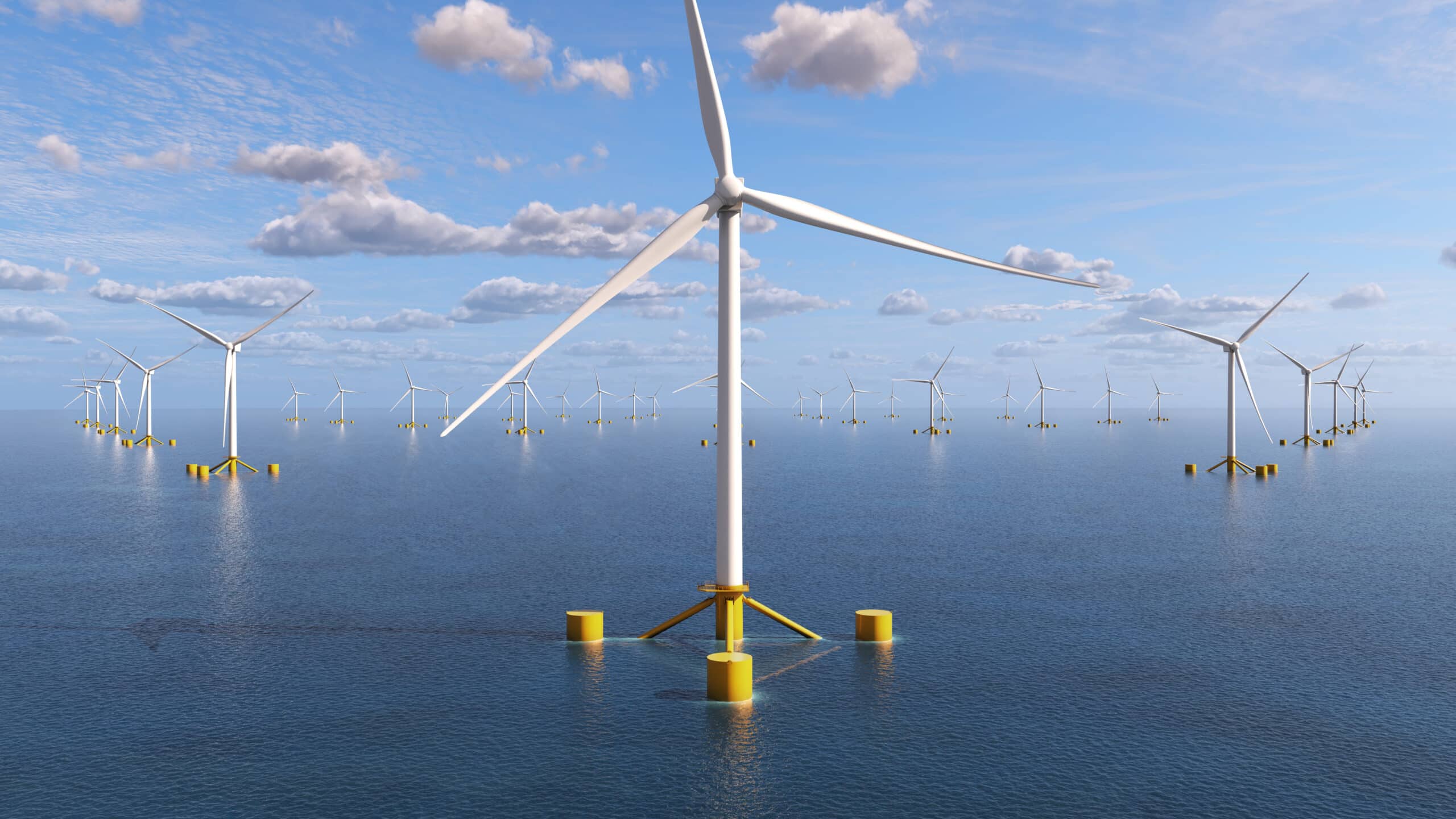
TetraSub: The industrialized deep-water foundation
A semi‑submersible floating foundation for 15+ MW turbines, built from standard tubular steel and assembled without welding.
The economics of industrialization
TetraSub replaces complex shipbuilding methods with industrial mass production.
Constructed entirely from standard factory-made tubular steel components, without costly stiffeners or quay‑side welding, the system addresses key cost drivers in floating foundations.
The result is a fabrication cost below 1 million Euro per MW, backed by binding supplier offers. The cost covers a floating foundation launched in the water and ready for turbine installation.
TetraSub product design

The TetraSub 15+ MW is a semi‑submersible floating foundation built entirely from standard tubular steel members. A modular design enables rapid, weld‑free assembly at the quayside.
The tetrahedral geometry provides a stiff‑stiff system with the wind turbine, delivering stability for ultra‑large turbines while supporting efficient integration and O&M.
System capabilities
| Turbine compatibility | 15+ MW (compatible w major Western & APAC OEM standards) |
| Water depth | 50m – 1000+ m |
| Footprint | 110 m x 90 m |
| Components | 12 modular components |
| Construction method | Modular assembly via structural connections (no welding) |
| Ballast system | Fully passive |
| Draft | Deployable from shallow draft ports (<10m) |
| Design life | 25+ years |
Core technology enablers
Fast weld-free assembly
At the core of the assembly method is Stiesdal Offshore’s pin connection system.
Key stats: 4 minutes per pin connection insertion in full size assembly tests. 32 minutes for the fastest brace lift and placement during TetraSpar assembly. Together, these metrics document fast assembly using standard cranes.
Designed for existing supply chains
TetraSub can be assembled in existing ports using local supply chains and contractors, with-out large quay side welding crews or specialised facilities.
Port requirements are flexible, and the assembly setup can be adapted to port specific layouts. A single assembly stand requires only 20,000 m².
Factory manufacture, port assembly
Modules are factory made, transported to the port of embarkation and assembled at quayside on a flat lay down area, with harbour depth typically from around 10 m and up.
Launch can be by slipway or semi submersible barge, turbine installation and pre commissioning can be done in port, and the unit can then be towed to site using widely available vessels.
Fully passive ballast system
The TetraSub floating foundation is built for low OPEX.
With a fully passive ballast system, failure prone active components such as pumps and valves are removed, and with no moving parts in the foundation, offshore maintenance needs on the structure itself are minimised.
Industrialised station keeping system.
Shared anchors and twin-line arrangement
Stiesdal Offshore offers the TetraMoor system, a shared-anchor, twin-line arrangement. The TetraMoor system allows multiple units to share anchor points and can reduce the total anchor count by more than 50% compared with individually anchored concepts. The twin-line arrangement favours the use of standard chain and line sizes and reduces mooring loads significantly.
The TetraMoor system can reduce overall mooring and anchoring costs by 30% or more compared to traditional mooring arrangements, depending on site conditions and project design.
Watch the modular assembly system

Video 1: Bearing installation during the TetraSpar Demonstrator assembly.

Illustration of a TetraSub line boring sequence.

Illustration of TetraSub pin installation sequence.

Crew performing a horisontal pin installation.

Crew performing a vertical pin installation.
Wind turbine size development
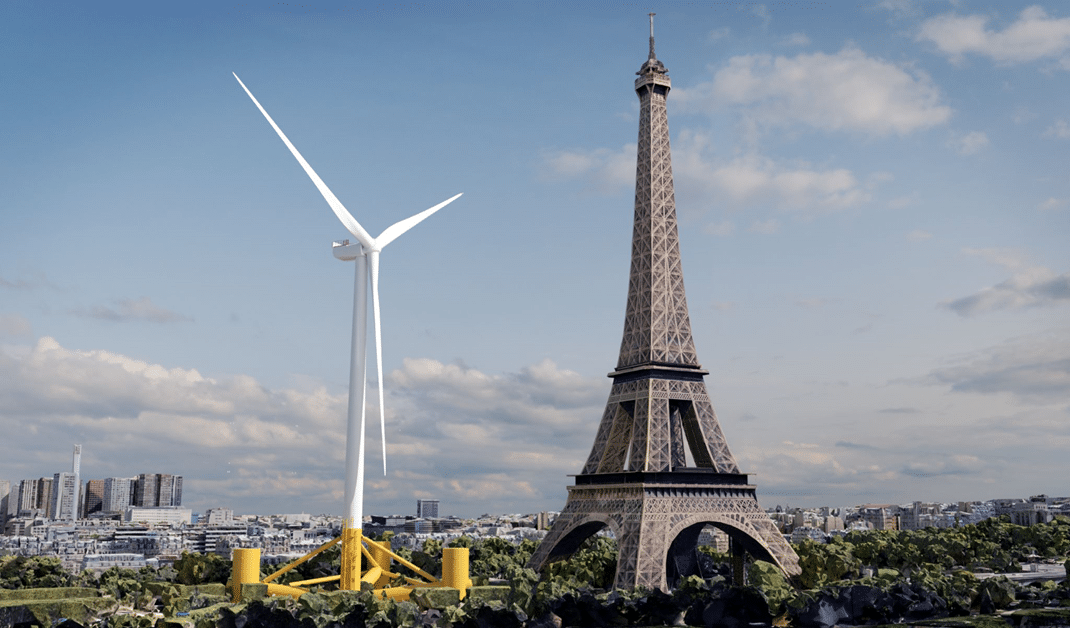
Offshore wind turbine ratings have grown exponentially, with a doubling time of about 10 years. Current development points to 20 MW turbines with 250+ metre rotors.
The TetraSub floating foundation is WTG‑agnostic and can be scaled to 20+ MW ratings without changing the core design principles.
Visualization of the TetraSub with a 15 MW turbine.
TetraSub – the universal “socket”
The TetraSub is engineered as a universal “socket” for the global wind industry. Stiesdal Offshore has pre‑validated interfaces with major Western and APAC OEMs to secure compatibility.
Beyond simple geometric fit, engineering covers load distribution, dynamic behaviour, and station keeping integration, resolving key interface topics early in the design process.
Verification and certification
The TetraSub is treated as a validated industrial product. We hold a Statement of Compliance (Basic Design) from DNV for the TetraSub platform, confirming structural integrity and adherence to industry standards.
Furthermore, DNV has issued a Bankability Assessment for the latest design generation, confirming its suitability for project financing and commercial deployment.
Stiesdal Offshore’s operations are supported by ISO 9001 (Quality Management) and ISO 45001 (Occupational Health & Safety) certification.
TetraSub development history

Stage 1: Validation with TetraSpar Demonstrator

Stage 2: The TetraSub Demonstrator

Stage 3: TetraSub Mark I

Stage 4: TetraSub Mark II
Frequently Asked Questions
Why the assymetrical T-shape?
The geometry of the TetraSub is optimised for operations and maintenance. The asymmetrical T‑shape brings the turbine interface closer to the flat side of the foundation, allowing the fully assembled foundation to be moored quayside while a standard land‑based crane installs the 15+ MW turbine. The T-shape also simplifies offshore turbine maintenance operations, particularly in the case of main component replacement.
Does the TetraSub require specialized deep-water construction ports?
No. A primary design criterion for TetraSub was to remove the dependence on deep‑water ports. The TetraSub features a shallow assembly draft (typically ~10 m), allowing assembly, launch, and commissioning at a wide range of standard industrial ports.
This flexibility increases the number of suitable assembly sites globally and allows developers to maximise local content by utilising existing infrastructure closer to the wind farm site.
Does the ballast system require active pumps or sensors?
No. The TetraSub uses a fully passive ballast system consisting of permanent water. Active systems relying on pumps, valves, and sensors require power and are more exposed to failure. Once installed, the passive ballast system requires no energy, monitoring, or maintenance over the lifetime of the asset, significantly lowering project OPEX.
What is your dynamic cable philosophy?
We utilise a lazy‑wave configuration optimised for deep water, reducing tension and fatigue on the power cables while accommodating the floater’s motion characteristics.
Have you collaborated with OEMs?
Yes. Stiesdal Offshore has performed generic project front‑loading and site‑specific studies with the three major Western OEMs as well as major APAC offshore OEMs to secure seamless integration.
How do you handle certification?
We work in parallel with certification bodies (DNV, Bureau Veritas, and ClassNK in Japan) from Pre‑FEED through Detailed Design to secure verification, enabling insurability and debt financing. The TetraSub is treated as a validated industrial product. We hold a Statement of Compliance (Basic Design) from DNV for the TetraSub platform and a Bankability Assessment for the latest design generation. For Japan, we are engaging with ClassNK towards approval as the design matures.
Stiesdal Offshore’s operational excellence is supported by ISO 9001 and ISO 45001 certification.
What is your engineering scope?
Stiesdal Offshore provides full‑scope engineering packages, including foundation design, interface definition, load and dynamics support, certification support, manufacturing and assembly method statements, and port and installation planning support.
What is your delivery scope?
We operate as a technology provider, licensing the TetraSub design and providing the technical framework for deployment. Delivery can include design and engineering packages, procurement support, supplier qualification and on‑site assembly support, integrated with wider project contracts.
How is Stiesdal’s TetraSub Mark II delivered?
Major components of Stiesdal’s TetraSub Mark II are sourced from qualified suppliers with relevant capacity. Stiesdal maintains a network of fabricators with the required quality and throughput in Europe and APAC, using established tower and heavy steel fabrication supply chains. Final assembly of TetraSub Mark II is completed in port using defined mechanical joining processes, minimising on‑site welding, inspection work, and rework before turbine installation. The preferred commercial model is a hybrid setup where the floater package is delivered under a dedicated supply and assembly scope with a limited number of interfaces. TetraSub can also form part of an EPC(I) scope as a defined supplier package aligned with the wider project contracts and interface framework.

Ready to scale?
Please reach out to Oliver Terman Pedersen, Head of Sales, if you have unanswered questions or want to discuss your floating wind project.